Your Website Is Costing You Clients and You Don't Even Know It

I need to tell you something that might be a little uncomfortable, but I promise it's coming from a place of genuine love for you and your business: if you're an esthetician who has been pouring energy into social media, showing up on Stories, creating reels, doing all the things you've been told to do, and you're STILL not seeing consistent bookings come through? There's a very real chance your website is the problem.
Not your content, not the algorithm, and not the fact that you didn't post at the "optimal time." It's your website.
I can't tell you how many times I've audited an esthetician's marketing and found that the issue wasn't visibility at all. They were actually getting traffic. People were finding them, clicking through from Instagram or Google, landing on their website, and then... leaving. No booking. No inquiry. Nothing. Because the website either didn't work properly, didn't communicate what they needed it to communicate, or made the booking process so confusing that the potential client gave up and moved on to someone whose site made it easier.
Your website is not a digital business card you set up once and forget about. It is the single most important conversion tool in your entire marketing ecosystem, and if it's not functioning the way it should, it is actively costing you money every single day. So let's talk about what's probably going wrong and, more importantly, how to fix it.
The Truth About First Impressions (and Why Your Homepage Matters More Than Your Instagram Grid)
Here's something that might surprise you: a potential client will form an opinion about your business within the first three to five seconds of landing on your website. That's it. Three to five seconds to decide whether they trust you enough to keep exploring or whether they're going to hit the back button and find someone else. And unlike your Instagram, where the algorithm might give your content a second chance in someone's feed, your website doesn't get a do-over. That first visit is often the only visit.
What does this actually mean for you practically? It means your homepage needs to immediately communicate three things: who you are, what you do, and how someone can book with you. That's it. Not your entire life story, not a paragraph about your "passion for skincare," not a stock photo of a woman with a towel on her head looking serenely into the distance. Your name or business name, the services you specialize in, the area you serve, and a clear button that says something like "Book Now" or "View Services." If a visitor has to scroll or click around to figure out what you actually do or how to become a client, you've already lost a percentage of them that you'll never get back.
And I want to address something I see constantly: estheticians who have gorgeous Instagram feeds but websites that look like they were built in 2017 and haven't been touched since. Your potential clients are absolutely checking your website before they book. They might find you on Instagram, fall in love with your content, tap the link in your bio, and then land on a website that looks completely different from the brand they just connected with. That disconnect is a trust killer. Your website needs to feel like a natural extension of your social media presence, not a totally different business.
Your Booking Process Is Probably Way Too Complicated
Let me paint a picture that I know is happening right now to at least a few of you reading this. A potential client finds you on Google or Instagram. She's interested. She clicks through to your website. She wants to book a facial. And then she has to: find the services page, scroll through a long list to find the right treatment, click on it to read a description, then look for a booking link that takes her to a completely separate platform, where she has to create an account, choose a date, choose a time, fill out her information, and THEN she can book. That's six, seven, eight steps between "I'm interested" and "I'm booked."
Every single step in that process is a place where you lose people. Every click, every new page, every moment of confusion or friction is an opportunity for that potential client to think "I'll do this later" (she won't) or "this is too complicated" (she'll find someone easier to book with).
The fix is to simplify ruthlessly, and I mean that. Your booking button should be visible on every single page of your website, not buried in a submenu somewhere your clients will never find. The path from "I want to book" to "I'm booked" should be as short and frictionless as humanly possible, and if your booking platform requires clients to create an account before they can even schedule, it's worth seriously asking yourself whether that platform is serving you or quietly costing you. I'd also encourage you to test your own booking process regularly by actually going through it on your phone (because that's where most of your clients are doing it) and noticing how it feels as a user, not as the business owner who already knows where everything is. If it takes you more than about 60 seconds to go from your homepage to a confirmed appointment, something needs to change.
If Your Site Doesn't Work on a Phone, It Basically Doesn't Work
This one is so important and so overlooked that I could probably write an entire blog post just about this. The vast majority of your potential clients are visiting your website on their phone. Not a laptop, not a desktop, their phone. And if your website wasn't designed with mobile in mind, or if it technically has a mobile version but it's clunky, slow, or difficult to navigate, you are losing people before they ever get to your booking page.
Here's what I want you to do right now (or at least today): pull up your website on your phone and go through it like you've never seen it before. Ask yourself whether you can read everything without zooming in, whether the images load quickly or take forever, whether the text is big enough to read comfortably, whether you can find your services and booking button within a few seconds, and whether your online booking system actually works smoothly on a phone screen or makes you do that annoying pinch-and-scroll thing that makes everyone want to throw their phone across the room.
If anything felt annoying, confusing, or slow, I promise you it feels the same way to your potential clients. And they're not going to push through the frustration the way you will because it's your business. They're going to leave and book with someone whose site works better on their phone. I know that sounds harsh, but it's the reality of how people make decisions in 2026, and I'd rather you hear it from me than keep losing clients you don't even know you're losing.
Google Is Looking at Your Website (Even if You're Not)
I talk to estheticians all the time who tell me they "don't really worry about SEO" because they get most of their clients from Instagram or word of mouth. And I always say the same thing: that's great, and also, you're leaving an entire stream of clients on the table by ignoring it.
When someone in your area Googles "facial near me" or "best esthetician in [your city]" or "microneedling [your city]," Google is deciding which businesses to show based in large part on their websites. And the factors Google cares about are the same things that make your website better for actual humans: is the site fast, is it mobile-friendly, does it have relevant content that answers the questions people are actually searching for, is the information organized in a way that makes sense?
You don't have to become an SEO expert to benefit from this, but there are a few things you can do that take almost no time and make a genuinely meaningful difference. Start by making sure your city and the services you offer are clearly mentioned on your homepage and your services page (not just buried in your Instagram bio where Google can't find them). Write a few real sentences about each service you offer rather than just listing the name and price, because Google needs actual content to understand what you do and who you serve. And make sure your business name, address, and phone number are consistent everywhere you're listed, whether that's your website, your Google Business Profile, Yelp, or any other directory, because inconsistencies confuse search engines and can hurt your rankings without you ever knowing it. These feel like small things, but they compound over time, and six months from now you could be getting inquiry calls and bookings from people who found you on Google without you having to lift a finger on social media to make it happen.
Your Website Should Build Trust Before You Ever Meet Someone
In the esthetics industry, trust isn't optional. People are handing you their skin, their confidence, and in many cases their vulnerability. They're not going to do that lightly, and your website is often where that trust either starts building or falls apart before you ever get a chance to meet them in person.
So what actually builds trust on a website? Real testimonials from real clients are huge, especially when they include specific details about their experience rather than generic "she's great!" one-liners that could be about literally anyone. Before-and-after photos that show genuine results (with proper consent, obviously) do more heavy lifting than most estheticians realize because they let someone imagine what's possible for THEIR skin. A professional photo of you matters more than you might think, because people genuinely want to see the face of the person they're going to be alone in a room with before they commit to showing up. And information about your training, your certifications, and your approach, shared not in a braggy way but in a way that quietly communicates "I know what I'm doing and I take your skin seriously," goes a long way toward making someone feel safe choosing you.
On the flip side, the things that erode trust are often the things you stop noticing because you see your own site every day. Broken links, pages that don't load, stock photos standing in for real images of your space and your work, outdated service menus or pricing from two years ago (if that's you, please go update it today), and a site that generally looks like it hasn't been touched in a long time. These might seem minor to you, but they send a subconscious signal to visitors that this business might not be active, might not be detail-oriented, or might not care enough to keep things current. And in an industry where attention to detail IS the service you're selling, that signal is absolutely devastating.
The Bottom Line: Your Website Is Working for You or Against You
There is no neutral ground here. Your website is either actively helping people find you, trust you, and book with you, or it's creating friction, confusion, and doubt that quietly sends them to someone else. And the most frustrating part is that most estheticians who are losing clients to a bad website have absolutely no idea it's happening, because those clients don't reach out to say "hey, I wanted to book but your site was confusing." They just quietly disappear and you never even know they existed.
The good news is that this is one of the most impactful things you can fix in your business, and you genuinely don't need to spend thousands of dollars or become a web developer to make it happen. Start with the basics: make sure your site looks good and works smoothly on mobile, simplify your booking process until it feels almost effortless, make sure your services and location are clearly communicated on the homepage, add real testimonials and real photos, and keep everything current. That alone will put you ahead of the majority of estheticians in your market who are still treating their website like a box they checked once in 2021 and haven't thought about since.
Your website should be your hardest-working employee, the one who shows up 24/7, never takes a day off, never calls in sick, and sends you clients while you sleep. And if it's not doing that right now, it's time to give it the attention it deserves.
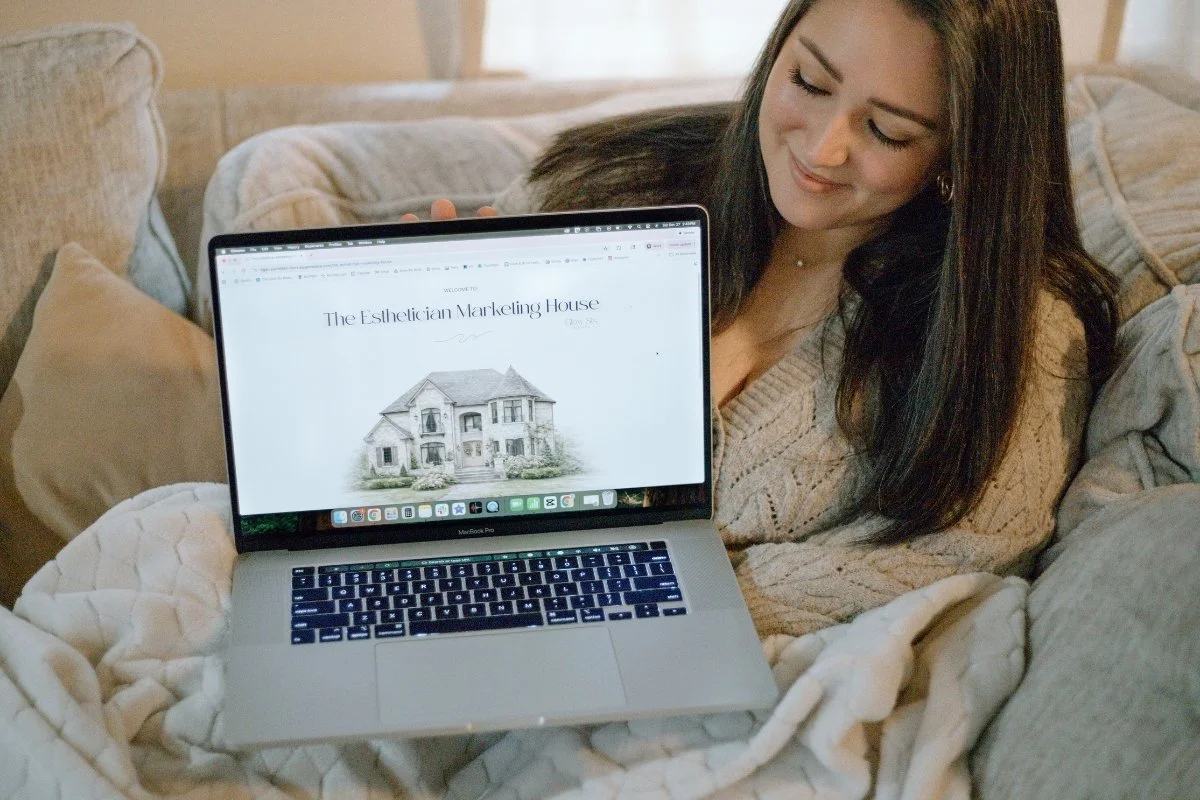
If you want to go deeper on website optimization, SEO, Google, and all the marketing strategies that go beyond social media, that's exactly what we cover inside The Esthetician Marketing House. It's a marketing ecosystem designed exclusively for esthetics professionals, and the Marketing Lab room is specifically dedicated to the strategies most estheticians never learn: Google, SEO, email, booking pages, and local outreach. New rooms are remodeled every month and you can reserve your key for $37/month. Use code TRYHOUSE for 50% off your first month.