The Hook Is the Marketing: Why the First Line of Your Content Matters More Than Anything Else

I want you to think about the last piece of content you posted. The one you actually spent time on, maybe rewrote the caption twice, adjusted the font on your graphic, and finally hit publish feeling pretty good about it. Now think about what happened next. If the answer is "not much," I want you to know something that might sting a little but is going to change the way you create content from this point forward: the problem almost certainly wasn't your content. It was your hook.
I've worked with thousands of estheticians worldwide at this point, and this is the pattern I see more than anything else. Incredibly talented, deeply knowledgeable professionals who are putting out genuinely valuable content and getting almost no traction from it. And when we dig into why, it's almost always the same thing. The first line of their post, their reel, their email, whatever it is, isn't giving anyone a reason to stop scrolling long enough to actually see the brilliance that comes after it.
The good news? This is one of the most fixable problems in your entire marketing strategy, and once you understand how hooks work, you'll never look at your content the same way again. So grab your coffee (or your wine, I don't judge) and let's get into it.
What Even IS a Hook and Why Does It Matter So Much?
A hook is simply the very first line of your content. It's the sentence someone reads or hears before they make a split-second decision to either keep going or keep scrolling. And it applies to literally everything you create: your Instagram captions, your reels, your TikToks, your emails, your blog posts, even the very first words out of your mouth when you start talking in a video.
Here's why this matters so much for estheticians specifically. Your dream clients are not on social media looking for you. I know that's a tough pill to swallow, but it's true. They're scrolling through hundreds of posts a day while they're in the school pickup line, or decompressing after work, or lying in bed at 10pm doing that thing where they tell themselves "five more minutes" for the third time. They're not actively searching for an esthetician to educate them about ingredient interactions or the importance of SPF. They're distracted, they're tired, and their thumb is moving fast.
Your hook is the thing that makes that thumb stop. It's the thing that cuts through all the noise of their feed and says, "Wait. This one's for me." And if your hook doesn't do that? It genuinely doesn't matter how incredible the rest of your content is because they're never going to see it.
What Makes a Hook Actually Work
Now that you understand what a hook is and why it matters, let's talk about what separates the hooks that work from the ones that don't. Because there IS a method to this, and once you see the patterns, you'll start recognizing them everywhere (which is honestly kind of fun and also slightly annoying because you'll never scroll the same way again 😂).
A strong hook does at least one of these four things:
It speaks to a specific person. When someone feels like you're talking directly to them, something in their brain lights up and they can't look away. "If you have acne-prone skin and you're still doing this in your nighttime routine, keep reading" lands completely differently than "Skincare tips for everyone." The first one makes someone think "oh no, am I doing something wrong?" The second one makes them think absolutely nothing because it sounds like every other post in their feed.
It opens a loop that the brain needs to close. This is genuinely one of the most powerful tools in content creation and it's rooted in psychology. When you say something like "I stopped recommending this popular ingredient to my clients and here's why," people NEED to know what the ingredient is. Their brain physically cannot let it go. That curiosity is what pulls them into the rest of your content, and it works every single time.
It challenges something they believe to be true. If you can respectfully push back on a widely held assumption, you've got their attention because now they need to find out if they've been wrong this whole time. "You don't need a 10-step skincare routine to get clear skin" is a scroll-stopper because it contradicts what the internet has been telling them for years, and they want to know what you know that everyone else apparently doesn't.
It promises something specific. This is the difference between content people scroll past and content people save. "How to get rid of texture on your cheeks in 3 treatments" tells someone exactly what they're going to learn and exactly what the outcome could be. There's no ambiguity, no guessing, just a clear promise that makes them think "yes, I need this."
The Hooks That Aren't Working (and I Say This With So Much Love)
OK, this part might feel a little called out but I promise it's coming from a place of wanting to help you because I have seen every single one of these approximately ten thousand times:
"Happy Monday! Here's a skincare tip for you."
"I love what I do and I'm so grateful for my clients."
"New blog post is up! Link in bio."
"Check out our latest service!"
These are not hooks. These are announcements. And the problem with announcements is that they give your audience absolutely zero reason to stop what they're doing and pay attention. There's no curiosity, no specificity, no "oh wait, is she talking to ME?" moment. They just blend into the feed like wallpaper.
And please hear me when I say this: I'm not telling you to stop being grateful or to never announce things. You absolutely should do both. But the announcement isn't the hook. The hook is what earns someone's attention so that they're actually there to receive the announcement, the gratitude, or the lesson you spent all that time creating.
Hook Formulas You Can Steal and Start Using Immediately
Alright, this is the part where we get really practical because I never want you to walk away from one of my lessons with just theory and no tools. Here are five hook frameworks that I teach inside The Esthetician Marketing House, along with examples you can literally adapt for your own content this week.
The "Stop Doing This" Hook
This one works because it immediately creates a little bit of tension, and tension is what keeps people reading. When you tell someone to stop doing something, they instantly want to know if they're guilty.
"Stop washing your face like this. It's making your breakouts worse."
"If you're still using makeup wipes to remove your makeup, we need to talk."
"The one thing you're doing after your facial that's undoing all the results."
The "I Made This Mistake" Hook
There's something incredibly compelling about someone who is clearly an expert being willing to say "I got this wrong." It builds trust because it's honest, and it builds curiosity because people immediately want to know if they're making the same mistake.
"I used to recommend this ingredient for hyperpigmentation. Here's why I stopped."
"The biggest skincare mistake I made in my 20s, and what I wish I'd done instead."
"I was wrong about retinol for years. Here's what changed my mind."
The Specific Number Hook
Numbers work because they're concrete and they set expectations. When someone sees a number, their brain already knows how much information is coming and it feels manageable, which makes them far more likely to engage.
"3 things I stopped doing to my skin that cleared my acne for good."
"1 product swap that changed my clients' skin in less than two weeks."
"5 skincare myths I hear from clients every single week.”
The "This Is for You" Hook
Direct callouts are powerful because they act as a filter. The people who relate feel instantly seen, and the people who don't just scroll past, which is exactly what you want because they were never going to be your client anyway.
"This one's for the woman who has tried everything for her acne and nothing has worked."
"If you're over 40 and confused about what your skin actually needs right now, keep reading."
"Calling all my dry skin girlies who are tired of looking flaky by noon."
The Curiosity Gap Hook
This is the open loop in its purest form. You hint at something valuable without giving it away, and the only way to find out what it is? Keep reading. It's almost unfair how well this works when you do it right.
"There's one product I recommend to every single client who walks through my door, and it's not what you think."
"The secret to glowing skin has nothing to do with your products."
"What if the reason your skin isn't clearing up has nothing to do with your skincare routine?"
Different Content, Different Hooks
Here's something that doesn't get talked about nearly enough: the type of content you're creating should influence the kind of hook you use. A hook that works beautifully in a carousel might completely fall flat in a reel, and vice versa.
For carousels and educational posts, lead with a hook that promises a clear takeaway. People swipe through carousels because they expect to learn something, so tell them exactly what they're going to get. "3 things your esthetician wishes you knew about retinol" works because there's no mystery about the format, just a promise of value that makes them want to swipe.
For reels and short-form video, your hook needs to be the very first thing you say, ideally within the first second or two. And I am lovingly begging you to stop starting your videos with "Hey guys!" or "So today I wanted to talk about..." because by the time you've finished that sentence, they're already gone. Walk into frame already mid-thought: "You're doing your double cleanse wrong and here's why." Match the energy to the urgency of the statement and don't waste a single second.
For email subject lines, I want you to start thinking of them as hooks because that's exactly what they are. You could write the most valuable, game-changing email of your entire career, but if the subject line says "Monthly Newsletter, May Edition" it is absolutely getting buried. Try something like "The one skincare mistake I see every single week" and watch the difference in your open rates. (And if you're not sending emails to your clients yet? That's an entire marketing channel you're leaving on the table and I'd love to help you change that. The Glow Sis Email Club was built to help you get started.)
For blog posts and long-form content, the first paragraph IS your hook. You have a few more sentences to work with than you do in a caption or a reel, but the principle is identical. Lead with something that makes the reader feel like you wrote this specifically for them and their exact situation. Make it personal, make it relevant, and give them a reason to keep going.
The One Mistake That Undermines Everything Else
I saved this for the end because if you take away nothing else from this entire article, I need you to take away this.
The single biggest mistake I see estheticians make with their hooks is writing them for everyone instead of writing them for their dream client. And I get why it happens, because it feels safer and more inclusive to keep things broad. But when you try to appeal to the masses, you end up resonating with absolutely no one. A hook like "Great skincare tips!" could be for literally anyone on the planet. It doesn't speak to the woman in her 30s who is dealing with hormonal breakouts, who has tried everything the internet has told her to try, and who is finally ready to trust a professional.
That woman is your client. Write your hooks for her. Get specific about her struggles, her questions, her frustrations, and the transformation she's looking for. When you write like you're sitting across from her having a real conversation, that's when your content starts to actually work.
That's when people stop scrolling.
That's when they start saving, sharing, and eventually booking.
And that, my friend, is how you turn content into clients. ✨
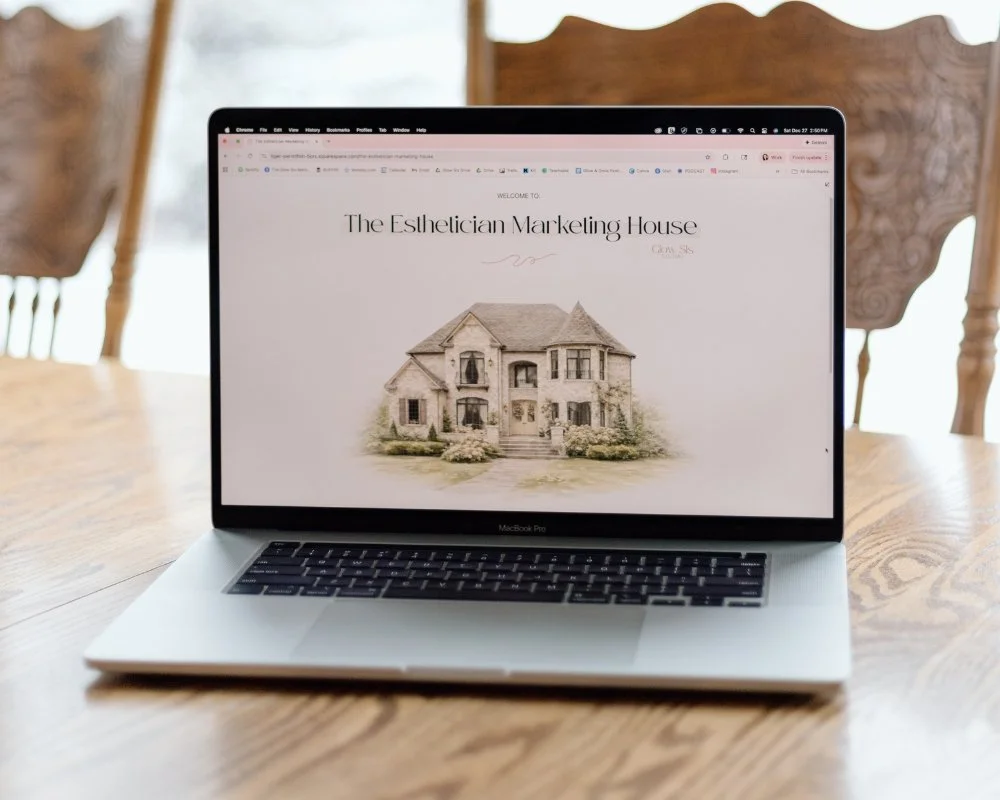
If this kind of education is what you've been looking for, I want you to know that The Esthetician Marketing House was built for exactly this. It's a marketing ecosystem designed exclusively for esthetics professionals that goes way beyond social media, covering email, SEO, Google, booking pages, local outreach, and the mindset side of showing up consistently even when it feels hard. New rooms are remodeled every month and you can reserve your key for $37/month. Use code TRYHOUSE for 50% off your first month.